Estimated reading time: 7 minutes
Backpacking for the guts of a year through the lesser spotted Americas (Central and South) created some prejudice. Not against the people, I should hasten to add. Most interactions with locals were pleasant, albeit infrequent, given the Lonely Planet path rarely converged with their own. Tourists, like myself, backed by the mighty dollar or euro happily frequented the restaurants and bars with the other sunburnt gringos, paying over the odds for food and drink in exchange for a semblance of home comfort – the soccer on TV, Guinness on draught or a Burger fries combo. Hardly ingratiating ourselves to the culture.
The prejudice stemmed from our want to paint multiple cities with the same brush. Each dust bowl town was a stopover that eventually would lead to a greater destination – one worthy of mention in the tourist books. These bright, energetic and noisy layovers merged into one. Rickety vehicles choking up the roads, aggressive sellers hopping between buses, stray dogs roaming for scraps and rundown shacks with corrugated metal roofs offering shade from a blazing sun.
South of Costa Rica in the beach town of Quepos was one such port.
The weather was a toasty 30 degrees, and I was spending the days leading up to Christmas on the beach, a stone’s throw from my hostel. In summary, it was paradise. Except for the fact that I was missing home and feeling melancholy about spending my first Christmas away from family and friends.
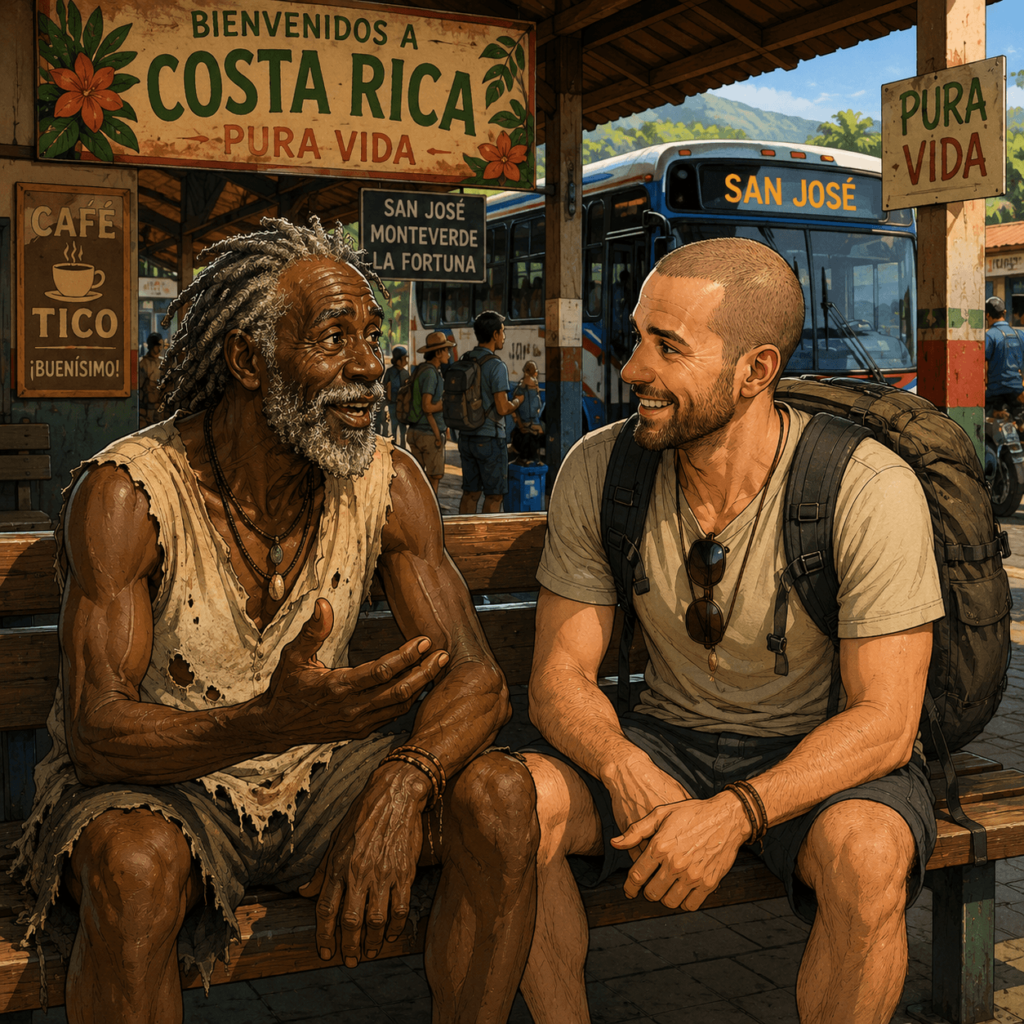
Tiring of beach life, I had decided to check out the city centre and explore the cheap stores, shedding some of my battered clothes for bargain replacements. However, I ended up spending too much time lounging around and missed the bus back to my hostel. It was only mid-afternoon at that point, and the next bus was an hour away, so I didn’t mind waiting and sat down on the bench with my well-thumbed tour guidebook. It would feel like a longer wait in this station.
There was a blur of movement in my peripheral vision, and I turned to see a man running toward me. He was dark-skinned and had a brown satchel flung over his shoulder. Even from a distance I could see that the clothes looked worn and about a size too big. As he got closer, the man’s pace dropped slightly until finally he sat down beside me trying to catch his breath.
“Do you speak English?” He finally asked.
I nodded. It brought a big smile to his deeply lined face and he removed his hat and wiped the sweat off his forehead with a big thumb.
“Great,” he said. “I think I just missed the bus. They ain’t as regular here as back home.”
We began talking and he started to tell me about his life.
He had left the States to fight in the Vietnam war in the late sixties. During that time he lost several good friends in battle and returning to the U.S. again, he found it incredibly difficult to plug back into civilization after the various traumas he had suffered.
With no family of note and no wife or kids he experienced a kind of “emotional flat-line” and realised that he was dying. He was quick to explain that it wasn’t in a physical sense, but that his hollowed out existence no longer resonated with his soul, and that he felt empty inside, devoid of purpose. After working in a drudgery job for most of the 70’s earning a comfortable wage, he decided to listen to the voice inside that had been beaten down over the years but still whispered gently to him in moments of quietude.
It told him to quit and see the world.
That was thirty years ago. Since then he had travelled the globe, with the last five years spent roaming Central America.
“‘Cos my soul soars and there’s cheap stores!“
Up until that point, I had listened patiently, waiting for the sales pitch. I had heard many sob stories during my travels from opportunists. After a dozen, you become hardened to even the most desperate of cases. Most westerners are singled out as easy prey and the desperadoes can be very aggressive if given an inch. To my surprise, I found that the longer we talked, the more I began to let my guard down. Perhaps my own soul was yearning for talk that pierced the fruitless patter that had accompanied hostel life.
Warming to the man, I couldn’t help but notice the sparkle in his eyes. A vitality that belied his advanced years. He told me that the one way he managed to maintain his sanity amidst the most extreme and difficult circumstances was through the art of boxing.
Before he was drafted into the Army he had had a moderately successful career as a prizefighter, winning the Golden Gloves boxing title. Unfortunately, injury cut short his time in the spotlight and he never had the chance to step up from the domestic scene and prove himself on the world stage. However, the lessons he learnt in boxing continued to serve him throughout his life, beyond the ring – in the battlefield – and in the game of life.
“Every day I still wake up at 6. Like clockwork. Go skippin’. Shadow box and do a thousand pushups.”
Perhaps to answer my sceptical look, he pulled up his baggy shirt sleeve and flexed a bicep. The muscle danced up and down like his arm was swallowing a rock.
“Not bad for a 66-year-old?“
He was in better shape than anyone I knew. He looked a couple decades younger.
We continued to chat, and I shared my travel itinerary. Most of the countries I had earmarked had already been visited by my new friend. He pointed out some of the best places that you couldn’t find in a guidebook.
Backpackers, vendors and locals paid us no heed, racing to catch the bus or coach service to the next destination. Under the shade of the station roof, we were lost in that moment, locked in conversation, untethered to any smart phone or device. Just two travelling souls on different paths meeting on this particular juncture; in this particular nondescript town.
I could tell from his clothes that although he was a drifter and might have been short on cash he never once asked for charity and gave freely of his time, knowledge and experience helping me map out the finer points of my route through Colombia and beyond.
As my bus pulled up a short time later, he gave me a warm bear hug and wished me a safe trip.
“I didn’t catch your name,” I said. He gave me one last big smile and a wink before shaking my hand. The strength in his arm was incredible.
“Jack. But people call me Black Jack.”
I often think about Black Jack now that I’ve returned to normality in Dublin. A single man in his retirement years, alone on the other side of the world. No family. No roots. Not many physical possessions. Travelling with just the clothes on his back, a few items in his satchel and relying on the generosity of others and the laws of the Universe.
When that bus driver pulled up and saw a skin-headed, sunburnt gringo hugging an elderly black man wearing rags, I wonder what went through his mind. Perhaps it was how two people from different backgrounds, and different generations could find a common connection. Or maybe he was thinking, look at how that homeless bum is trying to extort money out of the gullible Westerner. Idiots and their money.
But a rich life isn’t about our bank balance worth. Jack was one of the richest men I know and that zest for life is something money can’t buy.
This story was written for the ambitious creative project, ‘The Weekly Kook’, where I release a brand new short story every week for a year, totalling…yep, you guessed it – 52 stories.
To get the inside track on my motivation behind each story, please consider becoming a patron. Check out my Patreon.
Check all the stories here as I release them.